Lift Talk Notes - Dancing with Handcuffs: The Changing Geography of Trust in China
When I moved to China to do a year of continuous fieldwork, I didn't want to leave the country to give any talks. But when I got an invite from Lift Conference to speak, I didn't want to turn it down. I have been a fan of Lift Conferences for a long time and it was an honor to be invited. So I skipped out to Geneva for a week to speak at LIFT12. t
I was very excited to have LIFT be the first place I share my analysis. I chose to talk about the changing geography of trust as people and institutions are re-negotiating power in the age of online sociality in China. An excerpt of my talk from LIFT:
In her talk at Lift 12, she focuses on a story you may have heard of, concerning a student who ended up making international headlines for throwing shoes at the architect of China's internet censorship infrastructure and then become the hero for information freedom worldwide. Tricia tells us what happened to the student and how the outcomes were dependent on a variety of factors that tells us a lot about how we socialize and build trust online."
I was really happy with how the talk went. (some notes from
of my talk) There are so many other things I wanted to include so I want to elaborate on them here. But before I continue, there were many other speakers who had amazing talks that definitely are worth checking out. I've listed my favorites at the bottom of this post!
AHA MOMENT WITH CLAY SHIRKY in CHINA
I've been thinking about how communities form online for a long time. One of the best writers on this topic is
. When I read
Clay summarized piles and piles of scholarly research all into a few pages without any academic jargon. (Side note: the talent of conciseness and accessibility is sorely under-appreciated and under-developed in academia, and I would even go as far to say discouraged.)
In Chapter 2 From Sharing to Cooperation to Collective Action, Clay outlines how large-scale group activity unfolds.
- Sharing: "sharing creates the fewest demands on the participants....operate in a largley take it or leave it fashion, which allows for the max freedom of the individual to participate while creating the fewest complications of group life."
- Cooperation: "Cooperating is simply harder than sharing, because it involves changing your behavior to synchronize with people who are changing their behavior to synchronize with you. Unlike sharing, where the group is mailny an aggregate of participants, cooperating creates group identity - you know who you are cooperating with. One simple form of cooperation, almost universally with social tools, is conversational when people are in one another's company, even virtually, they like to talk...Collaboration production is a more involved form of cooperation, as it increases the tension between individual and group goals. The litmus test for collaborative production is simple: no one person can take credit for what gets created, and the project could not come into being without the participation of many. Structurally the biggest different between information sharing and collaborative production is that in collaborative production at least come collective decisions have to be made."
- Collective Action: "collective action, the third rung, is teh hardest kind of group effort, as it requires a group of people to commit themselves to undertaking a particular effort together, and to do so in a way that makes the decision of the group binding on the individual members. All group structures create dilemmas, but these dilemmas are hardest when it comes to collective action, because the cohesion of the group becomes critical to its success. Information sharing produces shared awareness among the participants, and collaborative production relies on shared creation, but collective action creates shared responsibility, by tying the user's identity to the identity of the group. In historical terms, a potluck dinner or a barn raising is collaborative production (the members works together to create something), while a union or government engages in collective action, action that si undertake in the name of the members meant to change something out in the world, often in opposition to other groups committed to different outcomes."
These 4 pages helped summarize over 10 years worth of books and articles I had been reading on this very same topic. It was beautiful. It gave me a framework to conceptualize the data that I had been collecting over the last few years. So I re-did my sticky note wall that looked like this:

and organized it into these 3 categories of group activity as outlined by Clay.

I put Sharing, Cooperation, and Collective Action on one axis, and then the topics (desire, consumption, social media, social issues, identity, labor) that I was looking at on another axis. Then I broke down each action that I could observe onto a sticky note and put it in the corresponding box of either Sharing, Cooperation, or Collaboration and under the corresponding topic. This forced me to focus on being clear about what I was observing and what is was an instance of.
Then I reorganized again and modified by adding a theory row.

and filled it all up…

to the point where the entire wall filled by the end of my fieldwork.

I love re-reading books because every time you read it you're in a new context with new questions. I had read Clay's book once when I was in the middle of course work at UCSD. But reading it this time in the field was a whole new experience. It gave me such an AHA moment that it rescued me from my massive sticky note dump. Most importantly, it helped me conceptualize how I could make sense of my data while in the field.
In my talk, I don't explicitly refer to Clay's explanation of Sharing --> Cooperation --> Collective Action, but it greatly informed the way I understood Han's story and the way I retold the events in my talk. Excerpt:
Even before he [Han] showed up at the university room that day, Han was already part of a larger collective of people sharing information, information that exposed new ideas, and ideas that eventually led to new behaviors. Although hundreds of people were involved in forwarding on the calls to harass Fan BingXin at his talk, it was accomplished with no formal chain of command, no organizational charts, and no personally known sources...
To understand how Han got here, we have to understand how trust is constructed in the context of China.
Social Graphs are for what?
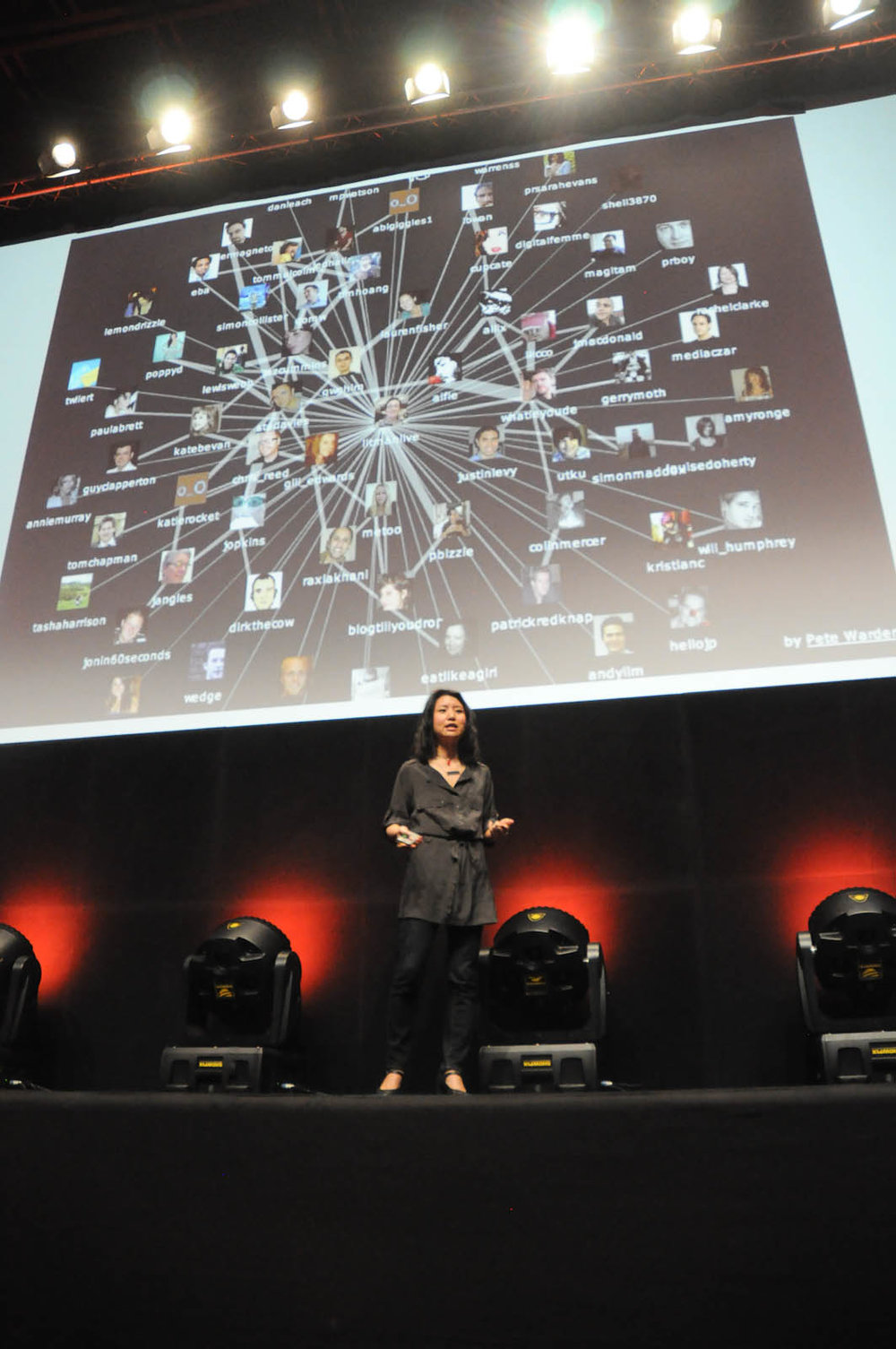
photo by Ivo Naepflin (CC-BY), slide image from Pete Warden
I spoke about social graphs in my talk:
The underlying idea in the social graph is that the more we do all of that sharing stuff, like forwarding, posting, and commenting, the more data that can be aggregated about our relationships and thus revealing things like common interests, influencers, and predictive behaviors.
The mathematical logic behind efforts to map the social graph relies on discrete definitions of people's relationships. This is problematic because it implies that the social graph is a web of trust, with the connection strength between ties as an indicator of the measurement of trust.
Sharing doesn’t always mean wetrust our connection or network, sometimes sharing means we’re trying to figure out trust. Andwe figure out trust not just as an individual embedded within webs of relationships, but embedded within webs of institutions.
But it's hard to algorithmically represent the strength ofindividual or institutionalaffiliations and how themeanings in these affiliationschange over time because it's all dependent on this fragile thing called trust that unfolds within the unpredictablecontingenciesof everyday life.
But I didn't get to elaborate enough about about my beef with social graphs. Our assumptions about the utility of the social graph doesn't just influence how we code relationships, but how we codify them, as if that was how we actually interacted. Coding online behaviors with algorithms is a slippery slope that easily leads us to treat what these algorithms reveal to be a blueprint of our social worlds. For example, a marketer or statistician inside a company would want to believe that these social graphs give accurate enough indicators about their consumers. And they do to certain degree as we learned from
. But these social graphs will always run into a wall called Meaning and Reality. Our information acts are laden with meanings that constantly change with context and time. Quantitative data sets, like social graphs, can only reveal so much data. Talking to, listening to, and observing people is still important in a world of abundant data sets.
Some other useful readings on the social graph:
- Brad Fitz's Thoughts on the Social Graph
- Maciej Ceglowski's The Social Graph is Neither
- The Future of the Social Web: Social Graphs Vs. Interest Graphs
DESIRE PATHS
I talked a bit about Desire Paths:
In the same way we see pedestrians creating desire paths to take them from where they are to where they want to be in the most efficient manner, we also see that users establish desires paths of trust with unknown sources.
We perform information acts act like favoriting, checking in, and liking, that serve as a set of trust-exploring practices to determine the least risky path to connect with someone. These are the unmarked roads that lead us outside of our social circles and into other circles and networks.
Desire paths decrease social distance.
I started thinking about the concept of desire paths when I saw aerial pictures of rivers carving their way through the earth, forming smaller off-shoots, capillaries, and then eventually reaching the ocean. I thought what a wonderful way to think about design - river are like users, let them find the way to where they want to be.


But users are complex and they don't always leave traceable marks like rivers. A better metaphor would be a quantum particle that tries to start many paths and then eventually settles on one.
Users have multiple needs needs and sometimes an app or product gives them the platform to carry out the need. This means that desire paths
aren't always user generated behavior, they can be emergent behavior. This distinction is really important to understand - we can't always assume that users will articulate their needs or even generate them because they develop when conditions line up between the market, the product, the learning curve, the culture, and the hardware.
But interestingly while emergent behavior may seem haphazardous, the process may mirror nature more than we think.

The electrons in this
picture are located in the olfactory bulb of a mouse.
The electrons are performing the "Quantum Random Walk" where the electrons in the smell receptors of the mouse move through multiple channels to trigger the single most optimal route. Recent studies hypothesis that Quantum Random Walks may be the underlying process in biological life and human information processing. This is BIG!!!! WOW! The way we process data in our brains may rest on quantum mechanics! So one way to think about it is that in the same way that electrons trigger smells using the Quantum Random Walk, users also make paths in systems using similar processes of randomness. In the end it's what the river, electron, or user decides to be most optimal.
Some universities don't even pave concrete paths until they see what paths emerge over time from their students.

When I started playing in the field of Human Computer Interaction (HCI), I learned about the importance of studying user behaviors as indicators for best design practices and new features in tech tools and apps. One of the terms for this bottom up design principle is Pave the Cowpath. (Look to
or great citations on Pave the Cowpath.)
Watching paths emerge over time means that you can eventually build features on top of the paths that your users created. When people aren't forced to take the highways or main streets, they will create the route that makes sense to them, like the cows in
Nathan Abel's beautiful aerial photographs of cattle trajectories
in the snowy plains of Denver. When paired next to
Eric Fischer's Twitter map of New York City
, the desire paths of web analytics and bovine behavior are quite beautiful.

Everything that we know about how people share information in their social networks needs to be situated in the context where the practice is taking place.
What we know about users in the US may not be reflected in users elsewhere. Sometimes the differences in user values and practices is small enough that it doesn't affect the overall service.
But sometimes, it does.
In my past work,
I've made the case that Google leaving China
wasn't just simply a matter of political miscommunication or that China pushed Google out, it's also that Google didn't make services that were relevant to Chinese users.
Most people in
there was such a service called "Google."
When we are designing platforms for contexts that are radically different form what we know, there are a few design research principles that are important to keep in mind .
1.) Lower the threshold for trust to be established with your users. Make it easy for them to judge the veracity of information sources.
2.) Do a thorough ethnographic study on how users conceive of information and trust. Ask questions like: What does search mean to the users? What is the history of information in this region/country/community? How is information access moralized?
What are the concerns around information? What are legal constraints on information practices? What are the trust-establishing practices?
2.) Designed minimally enough so that you can watch how users establish desire paths. And do this as soon as possible. This is one the of the tenets of The Lean Start-up and why Ruby is the preferred tool for rapid development - Ruby allows developers to get something to the user quickly. Analyze the emergent desire paths and see if you want to build services that extend those paths or cut those paths off.
For more on desire path,
Dan Lockton has written a really lovely literature review
summarizing the main developments over the years.
One of my favorite Chinese quotes is:
地上本没有路,走的人多了也成了路。
In reality there are no roads, only paths that emerge where people walk.
TRUST CREATING MECHANISMS WITH IMPERSONAL TIES
Electrons triggering smells in the quantum random walk act a lot like how users also make paths of trust in online networks.
I outlined in my talk about people's transition from relying on personal to impersonal ties:
Social circles consists of people we already know. Social network consists of entities that we don't have a personal relationship with - like individuals, search engines, websites, or organizations.
Circles reinforce our relationships, while networks expand them.
Whentrust comes into play, social circles build on existing relations of trust,while social networks build out new relations of trust.
This distinction,while it appears to be minor, matters for how we acquire and share information.
It becomes crucial for us to understand that people's trust-forming mechanisms for impersonal ties (networks) are different from personal ties (circles).
If your best friend and a stranger told you that your bag was stolen, the process you would use to verify this information from your friend and the stranger would be different. Trust building mechanisms with a source depends on the type of existing relationship we have with the source.
In the absence of personal ties, people go through a set of trust-practices to determine the least minimally risky path to establish a connection between themselves and the source, hence they create desire paths. And sometimes these paths, disrupt the internal consistency of institutions.

photo by Ivo Naepflin (CC-BY)
SHOUT OUTS
- The main protagonist of the story, our hero, @hanunyi, was so cool to share his story with me. Send him a message on twitter for his brave act!
- Thank you to Xiao Tie for introducing me to Hanunyi,
- A big shout out to Pete Warden for letting me use his social graph image in my slides. Using Pete's image is also very special, because if you remember a few years ago Facebook sued him for pulling in data.
- Thanks you to Lift's Nicolas Nova for inviting me - curating the panel.
- Thanks to Ayman Shamma for referring me to De Choudhury et. al.'s "Inferring relevant social networks from interpersonal communication" and Boshmaf et. al.'s "The Socialbot Network : When Bots Socialize for Fame and Money."
- Thanks to all those who read, advised, and listened to version(s) of the talk: Kevin Slavin, Kenyatta Cheese,An Xiao Mina, Kristen Taylor, and Pheona Chen
- Slide credit: The picture of Desire Paths is Rice Univeristy. | I used screenshots of tweets about the event from Issac Mao & Charles Custer. | Tannia Brannigan wrote a great story in The Guardian about Han's shoe throwing, I used the image in my slides also. | The google doc of all gifts offered to Han can be found here.
- In my last slide below, the image of giraffes is in honor of Pierre Croce who gave a talk on how to properly use powerpoints.


photo by Ivo Naepflin (CC-BY)
If you want to know more about the Chinese internet, here are some of my favorite go-to sites:
- 88 Bar - bias alert - I am one of the contributors
- China Digital Times
- Tech Rice
- Tea Leaf Nation
- Ministry of Tofu
- China Smack
- Sinica
- Danwei
OTHER LIfT TALKS TO CHECK OUT:
Tom Armitage's
Games: Systemic Media for a Systemic Age
Kars Alfrink's
The Social Contract Put at Play
James Bridle on
New Aesthetic and Robot Storytelling
JP Ragaswami on
independent
Open Source Nuclear Fusion by
---------------------------------------------------------
for more notes about my research, check out my latest post on how I write up my
fieldnotes on Ethnography Matters
and some recent
.
WORKS CITED
Talks force you get to the essence of your point. That means that there isn't a lot of room for theoretical speculations, rather the
theory needs to be hidden like underwear - worn on the inside, not outside.
But I love theory so much so I always try to sneak some into my talks. I've compiled a list of academiky readings below that inform the ways I approach the concept and practice of trust, social circles and networks, and institutional dynamics.
Boshmaf, Y., Muslukhov, I., Beznosov, K., & Ripeanu, M. (2011). The Socialbot Network : When Bots Socialize for Fame and Money.
ACSAC 11
. Orlando, Florida USA: ACM Press.
Online Social Networks (OSNs) have become an integral part of today’s Web. Politicians, celebrities, revolutionists, and others use OSNs as a podium to deliver their message to millions of active web users. Unfortunately, in the wrong hands, OSNs can be used to run astroturf campaigns to spread misinformation and propaganda. Such campaigns usually start off by infiltrating a targeted OSN on a large scale. In this paper, we evaluate how vulnerable OSNs are to a large-scale infiltration by socialbots: computer programs that control OSN accounts and mimic real users. We adopt a traditional web-based botnet design and built a Socialbot Network (SbN): a group of adaptive socialbots that are or- chestrated in a command-and-control fashion. We operated such an SbN on Facebook—a 750 million user OSN—for about 8 weeks. We collected data related to users’ behav- ior in response to a large-scale infiltration where socialbots were used to connect to a large number of Facebook users. Our results show that (1) OSNs, such as Facebook, can be infiltrated with a success rate of up to 80%, (2) depending on users’ privacy settings, a successful infiltration can result in privacy breaches where even more users’ data are exposed when compared to a purely public access, and (3) in prac- tice, OSN security defenses, such as the Facebook Immune System, are not effective enough in detecting or stopping a large-scale infiltration as it occurs.
Boyd, D., Golder, S., & Lotan, G. (2010). Tweet, Tweet, Retweet: Conversational Aspects of Retweeting on Twitter.
Twitter—a microblogging service that enables users to post messages (“tweets”) of up to 140 characters—supports a variety of communicative practices; participants use Twitter to converse with individuals, groups, and the public at large, so when conversations emerge, they are often experienced by broader audiences than just the interlocutors. This paper examines the practice of retweeting as a way by which participants can be “in a conversation.” While retweeting has become a convention inside Twitter, participants retweet using different styles and for diverse reasons. We highlight how authorship, attribution, and communicative fidelity are negotiated in diverse ways. Using a series of case studies and empirical data, this paper maps out retweeting as a conversational practice.
Boyd, D. M., & Ellison, N. B. (2008). Social Network Sites: Definition, History, and Scholarship.
Journal of Computer-Mediated Communication
,
13
(1), 210-230.
Social network sites (SNSs) are increasingly attracting the attention of academic and industry researchers intrigued by their affordances and reach. This special theme section of the Journal of Computer-Mediated Communication brings together scholarship on these emergent phenomena. In this introductory article, we describe features of SNSs and propose a comprehensive definition. We then present one perspective on the history of such sites, discussing key changes and developments. After briefly summarizing existing scholarship concerning SNSs, we discuss the articles in this special section and conclude with considerations for future research.
Boyd, D., Golder, S., & Lotan, G. (2010). Tweet, Tweet, Retweet: Conversational Aspects of Retweeting on Twitter.
Twitter—a microblogging service that enables users to post messages (“tweets”) of up to 140 characters—supports a variety of communicative practices; participants use Twitter to converse with individuals, groups, and the public at large, so when conversations emerge, they are often experienced by broader audiences than just the interlocutors. This paper examines the practice of retweeting as a way by which participants can be “in a conversation.” While retweeting has become a convention inside Twitter, participants retweet using different styles and for diverse reasons. We highlight how authorship, attribution, and communicative fidelity are negotiated in diverse ways. Using a series of case studies and empirical data, this paper maps out retweeting as a conversational practice.
Boyd, J. (2006). In Community We Trust: Online Security Communication at eBay.
Journal of Computer-Mediated Communication
,
7
(3).
As e-commerce and virtual communities fundamentally change the way Americans do business and build relationships, how can people be assured of safety in unfamiliar cyberspaces? This essay focuses on online auction site eBay to understand how eBay has successfully attracted millions of users in spite of perceived risks and uncertainties. It argues that eBay is, in fact, a community (of commerce), and that the rhetorical construction of “community” on the site provides a foundation for trust between users. Based on trust theory, this essay isolates eBay's “community trust” model as consisting of seven elements that work together to give users reasons to trust and to be trustworthy. Finally, the essay examines recent changes to eBay's system, suggesting that so-called improvements for control might actually weaken the “community trust” system already in place–a warning to other sites that might imitate eBay's community approach.
Boxu, Y. (2010). Social Spaces and New Media: Some Reflections on the Modernization Process in China.
Procedia - Social and Behavioral Sciences
,
2
(5), 6941-6947.
This essay takes a historical perspective and tries to illustrate the role of new media in current Chinese society. In doing so, the agents and their relationships to the media employed are identified and discussed in respect to the social spaces and structures. There was no public space in Chinese dynasties. The common people and official were regarded as “sheep” and governed by the emperor and his official, the “shepherd”. The Confucian scholars not only were very part of the officialdom but also articulated the necessary ideologies for the emperor and his state by means of the media technologies locally invented. This particular structure did not disappear completely after the disappearance of the last dynasty although newspapers and broadcasting media were introduced to the Chinese. But the recent economic reform has opened the door to not only transnational corporations but also new media communications. This time, the “sheep” becomes the user of the new media as agent. It seriously challenges the established ideologies and social structures by creating virtual public spaces and personalizing the real private spaces for the fist time in history. This essay explores the role of new media played in the changes of social space during the recent modernization process in China. The social space refers to public, private, and personal spaces. Such spaces were emerged and established in different stages of historical processes. The spaces are significant because they encourage structuration in particular directions by setting up clear boundaries for social interactions. However, such boundaries could be challenged by agents who want to substantial changes when new media become available. That is, each medium has its own bias as far as communication is concerned (Innis, 1991). While one group (class) might benefit from a medium’s diffusion and implementation, the other could suffer from the practice. Historically speaking, it has been well documented that major social changes often involve redefining social spaces with the assistance of media in the West (see Elias, 1994; Febvew and Martin, 1976). While the dynasty oriented Chinese history suggests that its social process is not closely related to media such as printing technologys adoption and post-adoption, iits current market oriented economy, participation in globalization and eagerness for modernization re-pose the questions on the relationship between social changes and new media in respect to the spaces. Are there great changes with the assistance of the new media in social structure and space? If so, who are the agents for the changes? This essay tries to clarify and answer the questions by focusing on agents, structures, and spaces. © 2009 Published by Elsevier Ltd.
Cheshire, C. (2007). Selective Incentives and Generalized Information Exchange.
Social Psychology Quarterly
,
70
(1), 82-100.
The goal of this research is to understand how generalized exchange systems emerge when information, as the object of exchange, produces a collective good. When individuals con- tribute information for a collective benefit, it can create a group-generalized exchange sys- tem that involves a social dilemma. I argue that two properties of information, replication and high jointness of supply, are crucial for understanding the nature of the social dilemma in these exchange systems. Combined with low-cost contributions, these special features of information can allow social psychological selective incentives to significantly encourage cooperation. Experiments were conducted to examine the independent effects of two social psychological selective incentives (social approval and observational cooperation) on shar- ing behavior in a generalized information exchange system. The results indicate that observ- ing high levels of cooperative behavior is beneficial in the short run, but ultimately it only leads to moderately higher levels of cooperation than when individuals cannot observe cooperative behavior. On the other hand, when individuals receive either high or low levels of social approval, it has a very positive, significant impact on cooperative behavior. This research has implications for real-world generalized information exchange systems such as those found on the Internet. In addition, the theory and results in this study can also be extended to public goods that share the features of low-costs contributions, replication, and high jointness of supply.
Cheshire, C. (2011). Online Trust, Trustworthiness, or Assurance?
American Academy of Arts & Sciences 49
, 49-58. Arlington, VA: Telecommunications Policy Research Conference.
Every day, individuals around the world retrieve, share, and exchange information on the Internet. We interact online to share personal information, ½nd answers to questions, make ½nancial transactions, play social games, and maintain professional and personal relationships. Sometimes our online interactions take place between two or more humans. In other cases, we rely on computers to man- age information on our behalf. In each scenario, risk and uncertainty are essential for determining pos- sible actions and outcomes. This essay highlights common de½ciencies in our understanding of key con- cepts such as trust, trustworthiness, cooperation, and assurance in online environments. Empirical evi- dence from experimental work in computer-mediated environments underscores the promises and perils of overreliance on security and assurance structures as replacements for interpersonal trust. These con- ceptual distinctions are critical because the future shape of the Internet will depend on whether we build assurance structures to limit and control ambiguity or allow trust to emerge in the presence of risk and uncertainty.
Cheshire, C., & Cook, K. S. (2004). The Emergence of Trust Networks under Uncertainty – Implications for Internet Interactions.
Analyse and Kritik
,
26
, 220-240.
Computer-mediated interaction on the Internet provides new opportunities to examine the links between reputation, risk, and the development of trust between individuals who engage in various types of exchange. In this article, we comment on the application of experimental sociological research to different types of computer- mediated social interactions, with particular attention to the emergence of what we call ‘trust networks’ (networks of those one views as trustworthy). Drawing on the existing categorization systems that have been used in experimental social psychol- ogy, we relate the various forms of computer-mediated exchange to selected findings from experimental research. We develop a simple typology based on the intersection of random versus fixed-partner social dilemma games, and repeated versus one-shot interaction situations. By crossing these two types of social dilemma games and two types of interaction situations, we show that many forms of Internet exchange can be categorized effectively into four mutually exclusive categories. The resulting classifi- cation system helps to integrate the existing research on trust in experimental social psychology with the emerging field of computer-mediated exchange.
Cheshire, C., Antin, J., Cook, K. S., & Churchill, E. (2010). General and Familiar Trust in Websites.
Knowledge, Technology & Policy
,
23
(3-4), 311-331.
When people rely on the web to gather and distribute information, they can build a sense of trust in the websites with which they interact. Understanding the correlates of trust in most websites (general website trust) and trust in websites that one frequently visits (familiar website trust) is crucial for constructing better models of risk perception and online behavior. We conducted an online survey of active Internet users and examined the associations between the two types of web trust and several independent factors: information technology competence, adverse online events, and general dispositions to be trusting or cautious of others. Using a series of nested ordered logistic regression models, we find positive associations between general trust, general caution, and the two types of web trust. The positive effect of information technology competence erases the effect of general caution for general website trust but not for familiar website trust, providing evidence that general trust and self-reported competence are stronger associates of general website trust than broad attitudes about prudence. Finally, the experience of an adverse online event has a strong, negative association with general website trust, but not with familiar website trust. We discuss several implications for online behavior and suggest website policies that can help users make informed decisions about interacting with potentially risky websites. Keywords Trust . Online interaction . Computer-mediated communication.
Cheshire, C., & Antin, J. (2010). None of Us Is As Lazy As All of Us: Social intelligence and loafing in information pools.
Information, Communication & Society
,
13
(4), 537-555.
In this paper we apply theory and research from sociology and social psychology to the problem of collective information sharing and exchange on the internet. We investigate the relationships between pre-existing dispositions to be cautious towards others, the propensity to exert more or less effort as a function of group affiliation, and contribution towards a collective goal. We find that individuals with average or lower levels of general caution are more likely to contribute to a collective pool of information, providing support for Yamagishi’s (2001) argument that less cautious individuals exhibit a type of social intelligence by engaging in risky but potentially rewarding social interactions. Consistent with the literature on social loafing, we find that abstract group affiliations have a negative effect on information sharing behaviour. However, the effect of group affiliation is mediated by one’s level of general caution. We argue that pre-dispositions to engage in socially risky situations are a critical element of individuals’ decisions to contribute to online information sharing systems or not. Keywords sociology; Web 2.0; ICTs; communication studies; computer-mediated communication.
Cheshire, C., & Antin, J. (2008). The Social Psychological Effects of Feedback on the Production of Internet Information Pools.
Journal of Computer-Mediated Communication
,
13
(3), 705-727.
In this paper we apply theory and research from sociology and social psychology to the problem of collective information sharing and exchange on the internet. We investigate the relationships between pre-existing dispositions to be cautious towards others, the propensity to exert more or less effort as a function of group affiliation, and contribution towards a collective goal. We find that individuals with average or lower levels of general caution are more likely to contribute to a collective pool of information, providing support for Yamagishi’s (2001) argument that less cautious individuals exhibit a type of social intelligence by engaging in risky but potentially rewarding social interactions. Consistent with the literature on social loafing, we find that abstract group affiliations have a negative effect on information sharing behaviour. However, the effect of group affiliation is mediated by one’s level of general caution. We argue that pre-dispositions to engage in socially risky situations are a critical element of individuals’ decisions to contribute to online information sharing systems or not. Keywords sociology; Web 2.0; ICTs; communication studies; computer-mediated communication.
Cook, K. S. (2003).
Trust in Society
(p. 464). Russell Sage Foundation.
Sociologists, political scientists, and management scholars draw on experimental findings to explore the many functions trust performs in social and political life, how people decide whom to trust, and how they prove their trustworthiness to others. The 13 studies emerged from a conference in Seattle and various workshops in New York City. Trust in Society explains how trust is fostered among members of voluntary associations—such as soccer clubs, choirs, and church groups—and asks whether this trust spills over into other civic activities of wider benefit to society. The book also scrutinizes the relationship between trust and formal regulatory institutions, such as the law, that either substitute for trust when it is absent, or protect people from the worst consequences of trust when it is misplaced. Moreover, psychological research reveals how compliance with the law depends more on public trust in the motives of the police and courts than on fear of punishment. The contributors to this volume demonstrate the growing analytical sophistication of trust research and its wide-ranging explanatory power. In the interests of analytical rigor, the social sciences all too often assume that people act as atomistic individuals without regard to the interests of others. Trust in Society demonstrates how we can think rigorously and analytically about the many aspects of social life that cannot be explained in those terms.
Cook, K. S., Snijders, C., & Chesire, C. (Eds.). (2009).
eTrust: Forming Relationships in the Online World
(p. 330). Russell Sage Foundation.
This book is a self-exemplifying case of its main claim: that reputation and reputation systems are central mechanisms in producing trust and encouraging trustworthiness. The book appears as Volume 14 in the Russell Sage Foundation series on trust, which has a high reputation for quality and innovativeness. Some of the editors and contributors to the volume are well known for their earlier outstanding work in the area of trust research. Thus we have good grounds to assume that both the publisher and the editors, having invested in their reputations over a long period of time, have strong reasons not to produce a “lemon.” There are blurbs by recognized scholars on the back cover. Furthermore the book is a contribution to the domain of science, where the reputation systems by means of peer-review are in place, and the authors could well expect that a review in Contemporary Sociology (with reputation of its own) would appear one day, which must have strengthened their motivation for academic trustworthiness. In fact, as I will try to show, the content of the book confirms these expectations and justifies the trust of potential readers.
Crary, J. (1992).
Techniques of the observer: on vision and modernity in the nineteenth century
(p. 171). MIT Press.
Jonathan Crary's Techniques of the Observer provides a dramatically new perspective on the visual culture of the nineteenth century, reassessing problems of both visual modernism and social modernity. This analysis of the historical formation of the observer is a compelling account of the prehistory of the society of the spectacle."
Dayal, Sandeep, Landesberg, H., Dayal, S., & Zeisser, M. (2003). How to build trust online. In O. Petrovic, M. Ksela, M. Fallenböck, & C. Kittl (Eds.),
Trust in the Network Economy
.
Fear of online fraud is just one factor that keeps many consumers from even considering digital transactions. Consumers also expect their identity and per- sonal information to remain confidential. In addition, they want to experience a comfort level in their dealings with the marketer. Since the beginning of e-com- merce, businesses have realized that they must respond to these concerns to de- velop repeat customers and a robust Web business. Marketers have to give con- sumers compelling reasons to share the private information that drives many of the unique features of the Internet. The problem arises from a lack of trust. The risks, however small, outweigh the benefits when a consumer fears exploitation of his or her finances and iden- tity. A survey by the Georgia Institute of Technology found that only 4% of on- line users routinely register at Web sites . The "Tenth WWWUserSurvey" found that two-thirds of those not registering at some sites report a lack of trust as one of their reasons. A telephone survey, "Worldwide Internet Tracking Study," conducted by the IntelliQuest Internet research firm found that in the first quarter of 1999,63% of online users reported that they hesitate to buy for fear of unwanted junk e-mail, up nearly 10% from a similar poll just six months earlier. These Web users will become buyers only when marketers overcome the lack of trust that paralyzes would-be shoppers. Our research of and experience with more than 50 e-businesses show that the online marketers pacing their industries do so by embedding trust into their interac- tions with consumers. They 're forging a broad logic of trust based on constant and interactive value exchange between the buyer and seller. In fact, trust is a part of a larger set of "three-dimensional benefits" that customers are demanding. Custom- ers are looking beyond functional benefits (such as quality and price) for process (better ways to research and buy) and relationship (trust and ongoing communica- tions) benefits. As a result, how companies present themselves and provide a rich set of 3-D benefits is just as important as the goods and services they are offering. Companies that create and nurture trust find that customers return to their sites repeatedly. CDNow,
, and Onsale generate well over half of their sales from site loyalists. Contrast this with a typical underperforming retail site where only a quarter of sales comes from repeat buyers. Sites without a core of loyal customers must devote more capital to customer acquisition efforts and eventually may find it difficult to survive.
De Choudhury, M., Mason, W. a., Hofman, J. M., & Watts, D. J. (2010). Inferring relevant social networks from interpersonal communication.
Proceedings of the 19th international conference on World wide web - WWW ’10
, 301. New York, New York, USA: ACM Press.
Researchers increasingly use electronic communication data to construct and study large social networks, effectively inferring unobserved ties (e.g. i is connected to j) from ob- served communication events (e.g. i emails j). Often over- looked, however, is the impact of tie definition on the corre- sponding network, and in turn the relevance of the inferred network to the research question of interest. Here we study the problem of network inference and relevance for two email data sets of different size and origin. In each case, we gener- ate a family of networks parameterized by a threshold con- dition on the frequency of emails exchanged between pairs of individuals. After demonstrating that different choices of the threshold correspond to dramatically different network structures, we then formulate the relevance of these networks in terms of a series of prediction tasks that depend on vari- ous network features. In general, we find: a) that prediction accuracy is maximized over a non-trivial range of thresholds corresponding to 5–10 reciprocated emails per year; b) that for any prediction task, choosing the optimal value of the threshold yields a sizable (∼ 30%) boost in accuracy over na ̈ıve choices; and c) that the optimal threshold value ap- pears to be (somewhat surprisingly) consistent across data sets and prediction tasks. We emphasize the practical utility in defining ties via their relevance to the prediction task(s) at hand and discuss implications of our empirical results.
Foucault, M. (1980).
Power/Knowledge: Selected Interviews and Other Writings, 1972-1977
. (C. Gordon, Ed.) (p. 288). Vintage.
Michel Foucault has become famous for a series of books that have permanently altered our understanding of many institutions of Western society. He analyzed mental institutions in the remarkable Madness and Civilization; hospitals in The Birth of the Clinic; prisons in Discipline and Punish; and schools and families in The History of Sexuality. But the general reader as well as the specialist is apt to miss the consistent purposes that lay behind these difficult individual studies, thus losing sight of the broad social vision and political aims that unified them. Now, in this superb set of essays and interviews, Foucault has provided a much-needed guide to Foucault. These pieces, ranging over the entire spectrum of his concerns, enabled Foucault, in his most intimate and accessible voice, to interpret the conclusions of his research in each area and to demonstrate the contribution of each to the magnificent -- and terrifying -- portrait of society that he was patiently compiling. For, as Foucault shows, what he was always describing was the nature of power in society; not the conventional treatment of power that concentrates on powerful individuals and repressive institutions, but the much more pervasive and insidious mechanisms by which power "reaches into the very grain of individuals, touches their bodies and inserts itself into their actions and attitudes, their discourses, learning processes and everyday lives" Foucault's investigations of prisons, schools, barracks, hospitals, factories, cities, lodgings, families, and other organized forms of social life are each a segment of one of the most astonishing intellectual enterprises of all time -- and, as this book proves, one which possesses profound implications for understanding the social control of our bodies and our minds.
Granovetter, M. (2005). The Impact of Social Structure on Economic Outcomes.
Journal of Economic Perspectives
,
19
(1), 33-50.
Social structure, especially in the form of social networks, affects economic outcomes for three main reasons. First, social networks affect the flow and the quality of information. Much information is subtle, nuanced and difficult to verify, so actors do not believe impersonal sources and instead rely on people they know. Second, social networks are an important source of reward and punishment, since these are often magnified in their impact when coming from others personally known. Third, trust, by which I mean the confidence that others will do the “right” thing despite a clear balance of incentives to the contrary, emerges, if it does, in the context of a social network. Economists have recently devoted considerable attention to the impact of social structure and networks on the economy; for example, see the economists’ chapters in Rauch and Casella (2001) (and the illuminating review essay of this volume by Zuckerman, 2003), as well as Dutta and Jackson (2003) and Calvo ́- Armengol (2004). However, I focus here on sociologists’ contributions. Sociologists have developed core principles about the interactions of social structure, informa- tion, ability to punish or reward, and trust that frequently recur in their analyses of political, economic and other institutions. I begin by reviewing some of these principles. Building on these, I then discuss how social structures and social networks can affect economic outcomes like hiring, price, productivity and innovation.
Granovetter, M. S. (1995).
Getting a job: a study of contacts and careers
. Chicago: University of Chicago Press.
This classic study of how 282 men in the United States found their jobs not only proves "it's not what you know but who you know," but also demonstrates how social activity influences labor markets. Examining the link between job contacts and social structure, Granovetter recognizes networking as the crucial link between economists studies of labor mobility and more focused studies of an individual's motivation to find work.
Green, N. (2006). On the move: technology, mobility, and the mediation of social time and space. In R. Hassan & J. Thomas (Eds.),
The New Media Theory Reader
(pp. 244-248). Open University Press.
The impact of new technologies has been profound. They have affected our experience of time and the coordination of (work and personal) activities, dislocated individuals from the collective, fragmented interactions, and disrupted current understandings of social relationships. Or so the argument goes. Green draws on the example of mobile telephony in order to question these presuppositions, highlighting the device’s role in reinforcing existing patterns found in everyday life. By outlining the mobile phone’s use in people’s lives and its role in institutional change, Green shows how many temporalities and experiences are relatively enduring, locally continuous and configured according to multiple daily rhythms and situated action. In contrast to grandiose claims about revolutionary change, control of time and mobility is shaped in a more understated manner by local factors and social practice.
Heberer, T., & Schubert, G. (2009).
Regime legitimacy in contemporary China: institutional change and stability
(p. 306). Routledge.
Using in-depth case studies of a wide-range of political, social and economic reforms in contemporary China this volume sheds light on the significance and consequences of institutional change for stability of the political system in China. The contributors examine howreformsshape and change Communist rule and Chinese society, and to what extent they may engender new legitimacy for the CCP regime and argue that authoritarian regimes like the PRCcan successfully generatestability in the same way as democracies. Topics addressed include: ideological reform, rural tax- for-fees reforms, elections in villages and urban neighbourhood communities, property rights in rural industries, endogenous political constraints of transition, internalising capital markets, the media market in transition, the current social security system, the labour market environmental policy reforms to anti-poverty policies and NGOs. Exploring the possibility of legitimate one-party rule in China, this book is a stimulating and informative read for students and scholars interested in political science and Chinese politics
Hardin, R. (2009).
How Do You Know?: The Economics of Ordinary Knowledge
(p. 256). Princeton University Press.
How do ordinary people come to know or believe what they do? We need an account of this process to help explain why people act as they do. You might think I am acting irrationally--against my interest or my purpose--until you realize that what you know and what I know differ significantly. My actions, given my knowledge, might make eminently good sense. Of course, this pushes our problem back one stage to assess why someone knows or believes what they do. That is the focus of this book. Russell Hardin supposes that people are not usually going to act knowingly against their interests or other purposes. To try to understand how they have come to their knowledge or beliefs is therefore to be charitable in assessing their rationality. Hardin insists on such a charitable stance in the effort to understand others and their sometimes objectively perverse actions. Hardin presents an essentially economic account of what an individual can come to know and then applies this account to many areas of ordinary life: political participation, religious beliefs, popular knowledge of science, liberalism, culture, extremism, moral beliefs, and institutional knowledge. All of these can be enlightened by the supposition that people are attempting reasonable actions under the severe constraints of acquiring better knowledge when they face demands that far outstretch their possibilities.
Hardin, R., Cook, K. S., & Levi, M. (Eds.). (2009).
Whom Can We Trust?: How Groups, Networks, and Institutions Make Trust Possible
(p. 348). Russell Sage Foundation Publications.
Conventional wisdom holds that trust is essential for cooperation between individuals and institutions—such as community organizations, banks, and local governments. Not necessarily so, according to editors Karen Cook, Margaret Levi, and Russell Hardin. Cooperation thrives under a variety of circum-stances. Whom Can We Trust? examines the conditions that promote or constrain trust and advances our understanding of how cooperation really works.
Ibrahim, Y. (2009). The art of shoe-throwing: shoes as a symbol of protest and popular imagination.
Media, War & Conflict
,
2
(2), 213-226.
The art of shoe-throwing has captured popular imagination and is here to stay as a form of popular political protest. In a recent incident, Chinese Premier Wen Jiabao became a near-victim of a notorious flying shoe during his visit to London in February 2009. Shoe-throwing has become a celebrated art form ever since an Iraqi journalist threw his shoes at then US President George W. Bush, eternally sealing Bush’s last presidential moments with the iconic image of the shoe. Popular acts of communication and protests enter new forms of relationships with audiences and global spectators beyond the political context and the shoe-throwing incident is no exception. It has been consummately appropriated into popular culture and entertainment in the multimedia platforms of the internet, transforming political images and political protests into voyeuristic entertainment for the masses.
Jiang, X., Hong, J. I., & Landay, J. A. (2002). Approximate Information Flows : Socially-Based Modeling of Privacy in Ubiquitous Computing.
n this paper, we propose a framework for supporting socially- compatible privacy objectives in ubiquitous computing settings. Drawing on social science research, we have developed a key objective called the Principle of Minimum Asymmetry, which seeks to m
, (January 2001), 176-193.
In this paper, we propose a framework for supporting socially- compatible privacy objectives in ubiquitous computing settings. Drawing on social science research, we have developed a key objective called the Principle of Minimum Asymmetry, which seeks to minimize the imbalance between the people about whom data is being collected, and the systems and people that collect and use that data. We have also developed Approximate Information Flow (AIF), a model describing the interaction between the various actors and personal data. AIF effectively supports varying degrees of asymmetry for ubicomp systems, suggests new privacy protection mechanisms, and provides a foundation for inspecting privacy-friendliness of ubicomp systems.
Jiang, M. (2012).
Internet Companies in China: Dancing between the Party Line and the Bottom Line.
Center for Asian Studies.
With over 500 million Internet users and 900 million mobile-phone subscribers by mid 2011, the Chinese Internet is an enormous market that has produced the spectacular rise of many Chinese Internet companies and attracted substantial foreign investment. This paper argues that, despite a great degree of liberalization of its market over the past 15 years, the Chinese Internet remains authoritarian in nature. Not only did the central government actively shape the infrastructure and rules of China‟s information superhighways, but recently it has also vigorously built state-controlled Internet companies, including a national search engine. The paper starts with an overview of the landscape of the Chinese Internet industry, followed by a review of the developmental trajectories of three important search companies in China – Baidu, Google, and Jike (the national search engine), whose stories are illustrative of the experiences of domestic, foreign and state Internet firms operating in China. The paper then outlines the Chinese government‟s regulatory policies towards the Internet industry, which it is argued have undergone three stages: liberalization, regulation, and state capitalism. It is recognized that the great prospect of the Chinese Internet is shadowed by, and often overshadowed by, the government‟s insistence on weaving a China Wide Web. Domestic and foreign Internet companies are invariably used, or restricted, for social control as the government painstakingly transplants its ideology into cyberspace. Such practice is not only morally degrading but also unsustainable in the long run. An assessment of Chinese government policy toward Internet firms operating in China is not merely an academic exercise; it raises ethical and policy concerns for foreign governments, international organizations, and investor communities in China‟s expanding Internet market.
Jiang, M. (2010). Authoritarian deliberation on Chinese Internet. Electronic Journal of Communication, 20, No.1 and No.2.
Modern authoritarianism relies on a combination of patriotism and legitimacy based on performance rather than ideology. As such, a modern authoritarian government has to allow for some forms of political discussion and participation from which popular consent to authoritarian rule is derived. With 335 million Internet users, 182 million bloggers, and 155 million netizens able to access the Internet through their mobile phones (CNNIC, 2009b), China presents an interesting case to examine public deliberation online. Adapting the concept of authoritarian deliberation (He, 2006a) from an offline environment to an online one, the article proposes four types of online spaces of authoritarian deliberation extending from the core to the peripheries of authoritarian rule: central propaganda spaces, government-regulated commercial spaces, emergent civic spaces, and international deliberative spaces. The paper discusses their characteristics and implications for political participation in China and argues that democracy need not be a precursor to public deliberation. Instead, public deliberation may flourish as a viable alternative to the radical electoral democracy in authoritarian countries like China.
ornai, J., Rothstein, B., & Rose-Ackerman, S. (Eds.). (2004).
Creating Social Trust in Post-Socialist Transition
(p. 272). Palgrave Macmillan.
One of the central characteristics of socialist states and societies has been the absence of trust--between the state and the citizens, and then among citizens themselves. The process of developing trust is thus a major issue facing post-Socialist countries, and this book brings together a group of leading scholars to examine barriers to and bulwarks of trust in theoretical, cross-national, and topical perspectives. From the distinctive paradox of illegal organizations--such as the Mafiya--relying on trust within but undermining it without, to the effects of transparency, the authors examine the bases of trust and the effects of its presence or absence. Throughout the analysis is grounded in the interaction of individuals and their social, political, and economic environments.
Kittl, C., & Petrovic, O. (2003). Trust in Digital Transactions and Its Role as a Source of Competitive Advantage in the Network Economy.
International Conference WWW
(pp. 21-29).
The network economy is characterized by the fact that businesses increasingly work together with others when producing their products and services. In the past, one mainly tried to reduce the risk, which is linked to networking by means of digital transactions, through legal/technical control systems However, it has become more and more clear in the meantime that while the use of legal/technical control systems is indisputably important, all by itself it is fighting a losing battle. At the moment, the first signals of a beginning paradigm shift can be detected: thinking in the dimension of security is followed by thinking about the factor of trust as the ultimate and decisive indicator for the willingness to actually carry out transactions in the network economy. In the economics, organizational, and strategy literature trust is considered extremely important for many kinds of interaction. For instance, some economists argue that trust is an essential “lubricant”, without even the simplest form of economic exchange can not occur. But especially in the context of digital transactions trust is often seen as a factor that can only make one unhappy if missing, but not as something that can actually motivate one to actively carry out a digital transaction. The aim of this paper is to show that trust can actually generate a surplus value and how it can even become an important source for sustainable competitive advantage in the network economy.
>Kiyonari, T., Yamagishi, T., Cook, K. S., & Cheshire, C. (2006). Does Trust Beget Trustworthiness? Trust and Trustworthiness in Two Games and Two Cultures: A Research Note.
Social Psychology Quarterly
,
69
(3), 270-283.
An important unanswered question in the empirical literature on trust is whether trust- ing begets trustworthiness. In two experimental games, with Japanese and American participants, respectively, we compared trust and trustworthiness to provide an answer to this question.The trustee in the standard Trust Game knows that he or she is trusted, whereas the trustee in the Faith Game does not know whether or not this is the case. Except for this fact, the trustee faces the same choice in both situations. If the simple fact that one is trusted by someone else makes a person more trustworthy to the truster, then the trustee in the Trust Game should behave in a more trustworthy manner. Our results indicate that trust does not beget trustworthiness, at least in one-shot games.The results also indicate that trust and trustworthiness are two sides of the same coin but are quite distinct, partially replicating the recent findings of Buchan, Croson, and Dawes. American trusters were more trusting than their Japanese counterparts in the Trust Game, whereas American trustees were less trustworthy. The nationality difference in trust and trustworthiness is less pronounced in the Faith Game.We conclude that trust researchers should consider the limitations of one-shot games in studying the determi- nants of trust and trustworthiness.
Lagerkvist, J. (2010).
After the Internet, Before Democracy: Competing Norms in Chinese Media and Society
(p. 325). Peter Lang Pub Inc.
Internet use, with new possibilities to share information and discuss news and politics, lead to democracy, or will it to the contrary sustain a nationalist supported authoritarianism that may eventually contest the global information order? This book takes stock of the ongoing tug of war between state power and civil society on and off the Internet, a phenomenon that is fast becoming the centerpiece in the Chinese Communist Party's struggle to stay in power indefinitely. It interrogates the dynamics of this enduring contestation, before democracy, by following how Chinese society travels from getting access to the Internet to our time having the world<U8217>s largest Internet population. Pursuing the rationale of Internet regulation, the rise of the Chinese blogosphere and citizen journalism, Internet irony, online propaganda, the relation between state and popular nationalism, and finally the role of social media to bring about China's democratization, this book offers a fresh and provocative perspective on the arguable role of media technologies in the process of democratization, by applying social norm theory to illuminate the competition between the Party-state norm and the youth/subaltern norm in Chinese media and society.
Lipp, P. (2003). On Technical Trust: an Introduction. In O. Petrovic, M. Ksela, M. Fallenböck, & C. Kittl (Eds.),
Trust in the Network Economy
(pp. 243-252).
When users are using computers to perform tasks that involve sensible informa- tion, they might worry if the computer system they are using is secure enough to protect that sensible information properly. Securing information is a problem which cannot be solved without proper technological solutions, and, on the oth- er hand, can also notbe solved fully by these solutions alone - a combination of rules , procedures and technical protection is required. In such a scenario, trust plays different roles. Users need to trust that the technology does what they expect it to do. This also implies trust in the design- ers and developers of such a system. Mechanisms like security evaluations and regulatory schemes may help to build trust. Trust also plays a very important role in communicating with other people or systems on the Internet. Usually, one trusts another person or some organisation more easily, if one has some kind of physical contact, like office buildings or face-to-face meetings (especially if one knows the other person from previous events). In an electronic environment, technology is required to replace those physical aspects of trust. Below we will discuss aspects on how technology helps to build trust in an electronic world.
Mackenzie, D. (2004).
Mechanizing Proof: Computing, Risk, and Trust
(p. 440). The MIT Press.
Most aspects of our private and social lives -- our safety, the integrity of the financial system, the functioning of utilities and other services, and national security -- now depend on computing. But how can we know that this computing is trustworthy? In Mechanizing Proof, Donald MacKenzie addresses this key issue by investigating the interrelations of computing, risk, and mathematical proof over the last half century from the perspectives of history and sociology. His discussion draws on the technical literature of computer science and artificial intelligence and on extensive interviews with participants.MacKenzie argues that our culture now contains two ideals of proof: proof as traditionally conducted by human mathematicians, and formal, mechanized proof. He describes the systems constructed by those committed to the latter ideal and the many questions those systems raise about the nature of proof. He looks at the primary social influence on the development of automated proof -- the need to predict the behavior of the computer systems upon which human life and security depend -- and explores the involvement of powerful organizations such as the National Security Agency. He concludes that in mechanizing proof, and in pursuing dependable computer systems, we do not obviate the need for trust in our collective human judgment.
MacKinnon, R. (2007). Flatter world and thicker walls? Blogs, censorship and civic discourse in China.
Public Choice
,
134
(1-2), 31-46.
The Internet simply because it exists in China will not bring democracy to China. It is a tool, not a cause of political change. So far, the Chinese government has succeeded through censorship and regulation in blocking activists from using the Internet as an effective political tool. Likewise, blogs may be a catalyst for long-term political change because they are helping to enlarge the space for collaboration and conversation on subjects not directly related to political activism or regime change. However their role in China is more likely to involve political evolution—not revolution.
Petrovic, O., Fallenbock, M., & Kittl, C. (2003). Paradigm Shift in the Network Economy: From Security to Trust. In O. Petrovic, M. Ksela, M. Fallenböck, & C. Kittl (Eds.),
Trust in the Network Economy
.
Efforts to make digital transactions secure are often necessary but never suf- ficient enough to increase the willingness of the transaction partners to actually carry out the transaction. As we shall see in section 2, besides security two more requirements have to be fulfilled in order to increase this willingness. First of all, the measures for the reduction of insecurity must be noticed by the transac- tion partners and they have to become familiar with them [TaThOO]. Second, there always remains a residual insecurity which can be compensated for only by building up trust in the partner and in the IT-system used. At the moment, the first signals of a beginning paradigm shift can be detect- ed: thinking in the dimension of security is followed by thinking about the factor of trust as the ultimate and decisive indicator for the willingness to actually car- ry out transactions in the network economy. This paradigm shift is characterized by the following corner-stones : the belief in the sufficiency of objective technical and legal security is fol- lowed by an increasing interest in the question of what actually determines the users' trust in digital transactions and how it develops, the assumption that security building components (SBCs) also increase the subjectively perceived security is followed by efforts to increase trust in se- curity building components and in the corresponding transaction partner by trust building components (TBCs) and finally, • the point of view that security is something that a system should have to the highest possible extent is followed by the perspective that trust can be con- sidered as an essential source of sustainable competitive advantages. In the future, it might well be necessary that progress in the development and the use of trust building components at least catches up with the progress in security building components, so that the possibilities of the network economy can actu- ally be fully exhausted and that businesses are able to build up sustainable com- petitive advantages. A closer look at this situation leaves one with the impression that by far not all of the relevant dimensions of trust in digital transactions have been equally put on the research and development agenda and therefore existing solution ap- proaches cannot be as efficient as one hoped they would be. Thus, the second chapter of the present paper tries to show the complex in- terrelation between benefit, insecurity and trust with the willingness to actually carry out a digital transaction. The third chapter classifies existing control sys- tems for security building, whereas the fourth chapter classifies measures for trust building. This classification includes current fields of research, products, legislative actions, committees and a survey of the literature. The fifth and final chapter depicts ways to implement the paradigm shift.
Porter, T. M. (1996).
Trust in numbers: the pursuit of objectivity in science and public life
(p. 324). Princeton University Press.
This investigation of the overwhelming appeal of quantification in the modern world discusses the development of cultural meanings of objectivity over two centuries. How are we to account for the current prestige and power of quantitative methods? The usual answer is that quantification is seen as desirable in social and economic investigation as a result of its successes in the study of nature. Theodore Porter is not content with this. Why should the kind of success achieved in the study of stars, molecules, or cells be an attractive model for research on human societies? he asks. And, indeed, how should we understand the pervasiveness of quantification in the sciences of nature? In his view, we should look in the reverse direction: comprehending the attractions of quantification in business, government, and social research will teach us something new about its role in psychology, physics, and medicine. Drawing on a wide range of examples from the laboratory and from the worlds of accounting, insurance, cost-benefit analysis, and civil engineering, Porter shows that it is "exactly wrong" to interpret the drive for quantitative rigor as inherent somehow in the activity of science except where political and social pressures force compromise. Instead, quantification grows from attempts to develop a strategy of impersonality in response to pressures from outside. Objectivity derives its impetus from cultural contexts, quantification becoming most important where elites are weak, where private negotiation is suspect, and where trust is in short supply.
Riegelsberger, J., Sasse, M. A., & McCarthy, J. D. (2005). The mechanics of trust: A framework for research and design.
International Journal of Human-Computer Studies
,
62
(3), 381-422.
With an increasing number of technologies supporting transactions over distance and replacing traditional forms of interaction, designing for trust in mediated interactions has become a key concern for researchers in human computer interaction (HCI). While much of this research focuses on increasing users’ trust, we present a framework that shifts the perspective towards factors that support trustworthy behavior. In a second step, we analyze how the presence of these factors can be signalled. We argue that it is essential to take a systemic perspective for enabling well-placed trust and trustworthy behavior in the long term. For our analysis we draw on relevant research from sociology, economics, and psychology, as well as HCI. We identify
contextual properties
(motivation based on
temporal, social,
and
institutional embeddedness)
and the
actor’s intrinsic properties
(ability, and motivation based on
internalized norms
and
benevolence)
that form the basis of trustworthy behavior. Our analysis provides a frame of reference for the design of studies on trust in technology-mediated interactions, as well as a guide for identifying trust requirements in design processes. We demonstrate the application of the framework in three scenarios: call centre interactions, B2C e-commerce, and voice-enabled on-line gaming.
Schiller, D. (2006).
How to Think About Information
. Urbana.
The Chinese Communist Party has chosen to base the legitimacy of its rule on its perform- ance as leading national power. Since national identity is based on shared imaginations of and directly tied to territory – hence place, this paper analyses both heterodox models for identification on the national and potentially competing place-based collective identities on the local level. This analysis, based on communication within a number of popular communication forums and on observation of behavior in the physical reality of today’s urban China, shows that communication within the virtual and behavior in the real world are not separated realities but form a new virreal spatial continuum consisting of imagined places both online and offline. I argue that ties to place are stronger and identities con- structed on shared imaginations of place are more salient the more direct the experience of place is – be the place real, virtual or virreal. Hence in China challenges to one-party rule will probably accrue from competing localized collective identities rather than from het- erodox nationalism.
Shamma, D. A., Shaw, R., Shafton, P. L., & Liu, Y. (2007). Watch What I Watch: Using Community Activity to Understand Content.
MIR’07
. Ausburg, Bavaria, Germany: ACM Press.
This paper presents a high-level overview of Yahoo Research Berkeley’s approach to multimedia research and the ideas motivating it. This approach is characterized primarily by a shift away from building subsystems that attempt to dis- cover or understand the “meaning” of media content toward systems and algorithms that can usefully utilize information about how media content is being used in specific contexts; a shift from semantics to pragmatics. We believe that, at least for the domain of consumer and web videos, the latter pro- vides a more promising basis for indexing media content in ways that satisfy user needs. To illustrate our approach, we present ongoing work on several applications which generate and utilize contextual usage meta-data to provide novel and useful media experiences.
Shklovski, I., & Kotamraju, N. (2011). Online contribution practices in countries that engage in internet blocking and censorship.
Proceedings of the 2011 annual conference on Human factors in computing systems - CHI ’11
(p. 1109). New York, New York, USA: ACM Press.
In this article we describe people’s online contribution practices in contexts in which the government actively blocks access to or censors the Internet. We argue that people experience blocking as confusing, as a motivation for self-censorship online, as a cause of impoverishment of available content and as a real threat of personal persecution. Challenging ideas of blocking as a monolithic, abstract policy, we discuss five strategies with which Internet users navigate blocking: self-censorship, cultivating technical savvy, reliance on social ties to relay blocked content, use of already blocked sites for content production as a form of protection and practiced transparency. We also discuss strategies that forum owners and blogging platform providers employ to deal with and to avoid blocking. We conclude by advocating for more research that acknowledges the complexity of the contexts in which all Internet users contribute to the Internet and social media.
Shapiro, S. P. (1987). The Social Control of Impersonal Trust.
American Journal of Sociology
,
93
(3), 623.
How do societies control trust relationships that are not embedded in structures of personal relations? This paper discusses the guardians of impersonal trust and discovers that, in the quest for agent fidelity, they create new problems. The resulting collection of procedural norms, structural constraints, entry restrictions, policing mechanisms, social-control specialists, and insurance-like arrangements increases the opportunities for abuse while it encourages less acceptable trustee performance. Moreover, this system sometimes leads people to throw good "money" after bad; they protect trust and respond to its failures by conferring even more trust. The paper explores the sources and consequences of the paradox that the guardians of trust are themselves trustees.
Shirky, C. (2009).
Here Comes Everybody: The Power of Organizing Without Organizations.
Penguin.
A revelatory examination of how the wildfirelike spread of new forms of social interaction enabled by technology is changing the way humans form groups and exist within them, with profound long-term economic and social effects-for good and for ill.
Sparks, B. A., & Browning, V. (2011). The impact of online reviews on hotel booking intentions and perception of trust.
Tourism Management
,
32
(6), 1310-1323.
A growing reliance on the Internet as an information source when making choices about tourism products raises the need for more research into electronic word of mouth. Within a hotel context, this study explores the role of four key factors that influence perceptions of trust and consumer choice. An experimental design is used to investigate four independent variables: the target of the review (core or interpersonal); overall valence of a set of reviews (positive or negative); framing of reviews (what comes first: negative or positive information); and whether or not a consumer generated numerical rating is provided together with the written text. Consumers seem to be more influenced by early negative information, especially when the overall set of reviews is negative. However, positively framed infor- mation together with numerical rating details increases both booking intentions and consumer trust. The results suggest that consumers tend to rely on easy-to-process information, when evaluating a hotel based upon reviews. Higher levels of trust are also evident when a positively framed set of reviews focused on interpersonal service.
Tufekci, Zeynep. (2007). Who Acquires Friends t hrough Social Media and Why? “ Rich Get Richer ” versus “ Seek and Ye Shall Find .”
Proceedings of the Fourth International AAAI Conference on Weblogs and Social Media
(pp. 170-177). Association for the Advancement of Artificial Intelligence.
There is an ongoing debate, not just among academics but in popular culture, about whether social media can expand people’s social networks, and whether online friends can be “real” friends. The debate refuses to die. This paper addresses this question subjectively, from the point of view of the user, and examines predictors of acquiring new friends through social media use. This is a multi method study with quantitative (n 617) and qualitative sections. Some previous studies have found a “rich get richer” effect where people who are socially active offline benefit most from online interactions. This paper examines whether online social ties become real friends subject to a self fulfilling prophecy: those who do not believe in online friendships are not likely to make such connections. I compare the “Rich Get Richer” and “Seek and Ye Shall Find” models by examining relationships between the amount of offline socializing, amount of online social activity and the belief in online friendships. Respondents’ attitudes as to online sociality are qualitatively examined. The results support one of the earliest theories of computer mediated communication: hyperpersonal interaction. It appears that some people perceive online interaction to concentrate on the conversation itself, rather than on appearances, and find it to be freer of social judgments. On the other hand, for other people, face to face interaction has inimitable features that simply cannot be replicated or replaced. African Americans are significantly more likely to meet new friends online. This study contradicts the idea that people who are more social offline are more social online, as well as the notion that it is only the social misfits who use social media to make new friends as there was no difference in the number of offline friends between those who made new friends online and those who did not.
Tufekci, Z. (2007). Can You See Me Now? Audience and Disclosure Regulation in Online Social Network Sites.
Bulletin of Science, Technology & Society
,
28
(1), 20-36.
The prevailing paradigm in Internet privacy litera- ture, treating privacy within a context merely of rights and violations, is inadequate for studying the Internet as a social realm. Following Goffman on self-presentation and Altman’s theorizing of privacy as an optimization between competing pressures for disclosure and with- drawal, the author investigates the mechanisms used by a sample (n = 704) of college students, the vast majority users of Facebook and Myspace, to negotiate boundaries between public and private. Findings show little to no relationship between online privacy concerns and infor- mation disclosure on online social network sites. Students manage unwanted audience concerns by adjusting pro- file visibility and using nicknames but not by restricting the information within the profile. Mechanisms analo- gous to boundary regulation in physical space, such as walls, locks, and doors, are favored; little adaptation is made to the Internet’s key features of persistence, searchability, and cross-indexability. The author also finds significant racial and gender differences.
Tufekci, Zeynep. (2008). Grooming, Gossip, Facebook and Myspace.
Information, Communication & Society
,
11
(4), 544-564.
This paper explores the rapid adoption of online social network sites (also known as social networking sites) (SNSs) by students on a US college campus. Using quantitative (n 1⁄4 713) and qualitative (n 1⁄4 51) data based on a diverse sample of college students, demographic and other characteristics of SNS users and non-users are compared. Starting with the theoretical frameworks of Robin Dunbar and Erving Goffman, this paper situates SNS activity under two rubrics: (1) social grooming; and (2) presentation of the self. This study locates these sites within the emergence of social computing and makes a concep- tual distinction between the expressive Internet, the Internet of social interactions, and the instrumental Internet, the Internet of airline tickets and weather fore- casts. This paper compares and contrasts the user and non-user populations in terms of expressive and instrumental Internet use, social ties and attitudes toward social-grooming, privacy and efficiency. Two clusters are found to influ- ence SNS adoption: attitudes towards social grooming and privacy concerns. It is especially found that non-users display an attitude towards social grooming (gossip, small-talk and generalized, non-functional people-curiosity) that ranges from incredulous to hostile. Contrary to expectations, non-users do not report a smaller number of close friends compared with users, but they do keep in touch with fewer people. Users of SNS are also heavier users of the expressive Internet, while there is no difference in use of instrumental Internet. Gender also emerges as an important predictor. These findings highlight the need to differ- entiate between the different modalities of Internet use.
Sztompka, P. (2000).
Trust: A Sociological Theory
(p. 228). Cambridge University Press.
Piotr Sztompka here presents a comprehensive theoretical account of trust as a fundamental component of human actions. Professor Sztompka's detailed and systematic study takes account of the rich evolving research on trust, and explains its meaning, foundations and functions. Piotr Sztompka illustrates and supports his claims with statistical data and his own impressive empirical study of trust, carried out in Poland after the collapse of communism. This conceptually creative and elegant work will be of interest to scholars and students of sociology, political science and social philosophy.
Vermaas, K., & Wijngaert, L. van de. (2003). The Disclosure of Personal Information on the Internet: User Motivation, Reliability and Price as Explaining Factors. In O. Petrovic, M. Ksela, M. Fallenböck, & C. Kittl (Eds.),
Trust in the Network Economy
(pp. 365-374).
The central question here is what personal information people are willing to provide on the Internet, and under what circumstances. It is not only the business community and government that may benefit from the opportunities ICT has to offer in this area, but citizens/consumers as well may use them to their advantage . The most important opportunity ICT has to offer in this respect is the possibility to obtain services that are tailor-made. Basi- cally this means that companies and government agencies can personalise their services. For example by setting up a service whereby citizens can obtain infor- mation that is tailored to a neighbourhood, a street or a person. Companies can better aim their marketing activities at individual customers (Hagel, 1999). As far as consumers are concerned, the advantages can be summarised in three words: an increase of gain, convenience and enjoyment.
Warner, M. (2005).
Publics and Counterpublics [Paperback]
(p. 334). Zone.
Most of the people around us belong to our world not directly, as kin or comrades, but as strangers. How do we recognize them as members of our world? We are related to them as transient participants in common publics. Indeed, most of us would find it nearly impossible to imagine a social world without publics. In the eight essays in this book, Michael Warner addresses the question: What is a public?According to Warner, the idea of a public is one of the central fictions of modern life. Publics have powerful implications for how our social world takes shape, and much of modern life involves struggles over the nature of publics and their interrelations. The idea of a public contains ambiguities, even contradictions. As it is extended to new contexts, politics, and media, its meaning changes in ways that can be difficult to uncover.Combining historical analysis, theoretical reflection, and extensive case studies, Warner shows how the idea of a public can reframe our understanding of contemporary literary works and politics and of our social world in general. In particular, he applies the idea of a public to the junction of two intellectual traditions: public-sphere theory and queer theory.
Weber, I. (2011). Mobile, online and angry: the rise of China’s middle-class civil society?
Critical Arts
,
25
(1), 25-45.
This article examines the role and power of online media in representing an emerging culture of social activism and protests in both urban and rural China. It focuses on the discursive practices of China’s citizenry in utilising the global dimensions of online media within a localised and situated context, to reflect upon, construct and transform social practices with Chinese characteristics. This article utilises a cross-case method to compare and contrast online and mobile social activism in Shanghai, Xiamen, Tibet and Xinjiang. It examines these dynamics against the backdrop of an emerging Chinese middle class, which has been supported by the Chinese government’s economic reform as a way to build a more consumer-oriented, affluent and stable Chinese society. This analysis is framed within the extensive theoretical underpinnings of social theory and civil society, specifically the work of Pierre Bourdieu on capital accumulation and social differentiation. The article concludes that while the Chinese middle class may not be politically docile and can achieve social change, it does so based on self-interest while being mindful and wary of how its actions are perceived by authorities, thus managing protests carefully so the middle class can continue to reap the economic rewards of state capitalism. Consequently, any move towards democratic structures facilitated through online and mobile communication will be slow and carefully managed in a way that benefits the government and the current power structure, especially when focusing on politically and socially sensitive issues such as sovereignty. Keywords: China, Internet, mobile technologies, protests, social activism.
Yang, F. (2007). Cultural Dynamics in China: Today and in 2020.
China Quarterly
,
4
(4), 41-52.
This essay focuses on three ideological currents presently underpinning the Chinese cultural sphere:
Marxism-Leninism-Maoism (MLM), socio-political liberalism,
and
Confucianism.
These three major streams have all made considerable advances over the past twenty years, updating their rhetoric and in some cases reshaping their doctrinal foundations to be more accessible to both the masses and the ruling elite: 1.)
Since MLM continues to reap the support of the Chinese Communist Party (CCP), largely by providing an ideological basis that legitimizes Communist rule, it is unlikely to be abandoned anytime soon; 2.)
Socio-political liberalism, meanwhile, has been pushed forward by the growing intelligentsia, the emergence of non-profit organizations and the spread of Christianity; 3.)
The growing popularity of religious Confucianism—evidenced by the restoration of Confucius temples and memorial rituals throughout the country, the widespread of reading Confucian classics among school children and adults, and the proliferation of
guoxue
or Confucius institutes—provides a counterweight to the first two cultural currents.
By 2020 a combination of these ideologies, rather than a single one, will likely prevail. The interaction of these forces will have major implications not only for China’s cultural realm but for the political and economic realms as well, and can be conceived broadly as combining in three main possible ways.
Yang, G. (2009).
The Power of the Internet in China: Citizen Activism Online
. Columbia University Press.
Since the mid-1990s, the Internet has revolutionized popular expression in China, enabling users to organize, protest, and influence public opinion in unprecedented ways. Guobin Yang's pioneering study maps an innovative range of contentious forms and practices linked to Chinese cyberspace, delineating a nuanced and dynamic image of the Chinese Internet as an arena for creativity, community, conflict, and control. Like many other contemporary protest forms in China and the world, Yang argues, Chinese online activism derives its methods and vitality from multiple and intersecting forces, and state efforts to constrain it have only led to more creative acts of subversion. Transnationalism and the tradition of protest in China's incipient civil society provide cultural and social resources to online activism. Even Internet businesses have encouraged contentious activities, generating an unusual synergy between commerce and activism. Yang's book weaves these strands together to create a vivid story of immense social change, indicating a new era of informational politics.
Zhang, L. L. (2006). Behind the “Great Firewall”: Decoding China’s Internet Media Policies from the Inside.
Convergence: The International Journal of Research into New Media Technologies
,
12
(3), 271-291.
This study examines China’s current internet media policy in terms of the nature of the policy, the policymaking process, major forces driving the policy and future trends. Through face- to-face, in-depth interviews of 19 high-ranking Chinese policymakers, this study provides unusual insight on these issues from an inside perspective. A ‘push and control’ internet policy suggests that the leadership has relaxed in its ideological claims, yet still wants to control online content. China has also shifted the media policymaking process from the Party to government operation. The Party’s road map for economic prosperity has been a key driving force in this shift and ensures that internet policy is heading in a positive direction, though it is not straightforward. Finally, the policymakers’ attitudes toward the new media and value transformation have had a significant influence on policy formation. The study proved premises from both communication and develop- ment and media dependency theories with regard to the case of the internet in China. It is the first research project of its kind on the topic.
Zhao, Y. (2008).
Communication in China: Political Economy, Power, and Conflict
. Rowman & Littlefield Publishers, Inc.
The stakes for control over the means of communication in China have never been so high as the country struggles with breathtaking social change. This authoritative book analyzes the key dimensions of the transformation in China's communication system since the early 1990s and examines the highly fluid and potentially explosive dynamics of communication, power, and social contestation during China's rapid rise as a global power. Yuezhi Zhao begins with an analysis of the party-state's reconfiguration of political, economic, and ideological power in the Chinese communication system. She then explores the processes and social implications of domestic and foreign capital formation in the communication industry. Drawing on media and Internet debates on fundamental political, economic, and social issues in contemporary China, the book concludes with a nuanced depiction of the pitched and uneven battles for access and control among different social forces. Locating developments in Chinese communication within the nexus of state, market, and society, the author analyzes how the legacies of socialism continue to cast a long shadow. The book not only provides a multifaceted and interdisciplinary portrait of contemporary Chinese communication, but also explores profound questions regarding the nature of the state, the dynamics of class formation, and the trajectory of China's epochal social transformation.
Zittrain, J. (2008).
The Future of the Internet--And How to Stop It
. New Haven & London: Yale University Press.
explains the engine that has catapulted the Internet from backwater to ubiquity—and reveals that it is sputtering precisely because of its runaway success. With the unwitting help of its users, the generative Internet is on a path to a lockdown, ending its cycle of innovation—and facilitating unsettling new kinds of control. As tethered appliances and applications eclipse the PC, the very nature of the Internet—its “generativity,” or innovative character—is at risk.
The Internet’s current trajectory is one of lost opportunity. Its salvation lies in the hands of its millions of users. Drawing on generative technologies like
that have so far survived their own successes, this book shows how to develop new technologies and social structures that allow users to work creatively and collaboratively, participate in solutions, and become true “netizens.